

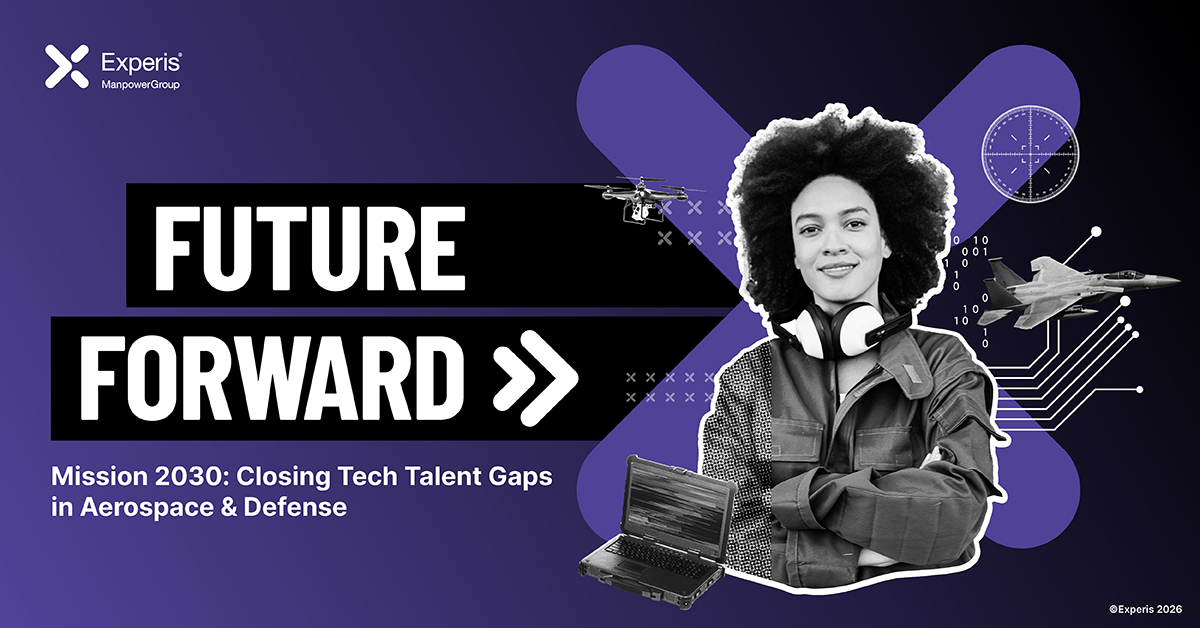
Amsterdam, 6 May 2026 – The global aerospace and defense sector is growing rapidly, but its ability to scale up is under increasing pressure due to a structural shortage of technical talent. Technical production workers, engineers, AI and IT specialists are especially scarce, while it is precisely these positions that determine production, innovation and digital resilience. This is evident from Mission 2030: Closing Tech Talent Gaps in Aerospace & Defense, a new international report by Experis and ManpowerGroup.
High outflow, ageing population and competition increase pressure
The pressure on the sector is now structural. According to the report, 72 percent of employers say they are struggling to find the right talent. The outflow is around 15 percent, twice as high as the average in other sectors. In the manufacturing industry, as many as 42 percent of employees are considering changing jobs within six months. In addition, 55 percent of manufacturers expect that aging and retirement will have a significant impact in the coming years. For example, a quarter of aviation engineers are over 55 years old.
Competition for technical talent is also increasing. Of all engineering graduates, only 60% are qualified to work in the aviation sector. In addition, large technology companies often offer higher entry-level salaries and more attractive conditions, making it difficult for aerospace and defense organizations to attract and retain young talent.
This combination of factors increases talent shortages, increases pressure on existing teams, and inhibits innovation and delivery capacity.
Digitization accelerates skills mismatch
The aerospace and defense sector is digitizing at a rapid pace. Technologies such as AI, digital twins and blockchain, and the increasing importance of cybersecurity require new skills, while education and internal training do not always match this. In addition to technical expertise, employers also cite skills such as collaboration, adaptability and problem-solving skills as essential, but difficult to find.
The report shows that closing skills gaps requires more than additional recruitment. Think of targeted upskilling and retraining through specialized academies. Or predictive workforce data, flexible deployment of specialist talent and the redesign of functions in which people and technology reinforce each other. It is all necessary to maintain capacity and prevent further workload and outflow.
International challenge, European dependence
The problem is global. In Europe, the defense industry directly employs more than 1.1 million people and supports around 4.2 million jobs, including indirect employment. Because industrial and defense chains are highly intertwined, the shortage of technical talent directly translates into delays, higher workloads and limited scalability. Talent availability is therefore increasingly becoming a strategic precondition for growth, security and autonomy.
Marceline Beijer, Global Vertical Leader Aerospace & Defense at ManpowerGroup and co-author of the report:
“The sector is struggling with the conditions to meet the growing demand. Digital transformation, geopolitical uncertainty and an ageing population come together here. Without fundamentally different choices in how technical talent is developed and deployed, scaling up under high pressure will become increasingly difficult.”
Andre Secrest, Managing Director ManpowerGroup:
“The Netherlands shares characteristics with other highly developed aviation and defense ecosystems, such as Germany and the UK: a strong technological base, but also a growing vulnerability due to an ageing population and scarcity of technical talent. The patterns from this international study are therefore very recognizable. The question is not whether this affects the Netherlands, but how quickly and specifically action will be taken to maintain executive power. Scaling up in aviation and defense requires well-functioning ecosystems and closer cooperation within chains and across borders – between companies, education and public parties – to keep talent sustainably employable.”
Link:
About the ManpowerGroup Employment Outlook Survey
Mission 2030: Closing Tech Talent Gaps in Aerospace & Defense was developed by Experis and the ManpowerGroup Work Intelligence Lab and is based on international labor market data, industry analysis, and employer insights from North America and Europe.
Source ManpowerGroup
Karlijn Meijer
+31 (0)6 34 63 57 63
karlijn.meijer@manpowergroup.nl
About ManpowerGroup and Experis
ManpowerGroup® is the global leader in finding, developing and retaining talent. From the brands Manpower, Experis and Talent Solutions, the HR service company offers complete HR solutions in more than 70 countries. Every year, ManpowerGroup connects millions of people with meaningful work. Whether temporary or permanent positions, in a wide range of sectors and fields, ManpowerGroup helps organizations and candidates to continue to succeed in a rapidly changing labor market.
Experis connects highly qualified IT professionals with organizations and offers flexible resourcing solutions. With IT capacity, expertise and scalability, Experis realizes digital projects and future-proof teams. Through the Experis Academy and coaching, Experis strengthens skills and growth, so that IT experts immediately add value in a rapidly changing technological landscape.
For more information, please visit our websites www.manpowergroup.nl and www.experis.nl or follow us ManpowerGroup Netherlands and Experis Netherlands.